A carpet cleaning machine can clean the surface of an area rug. A professional rug washing facility is designed to clean the rug from the fibres all the way through its foundation.
There is an important difference between **rug washing vs carpet cleaning**, although at first glance the two can seem suspiciously similar.
Both involve rugs.
Both involve water.
Both involve cleaning equipment.
And both are generally preferable to turning the rug upside down in the backyard and hoping gravity eventually sorts everything out.
But that's roughly where the similarities end.
Think of it this way.
You can technically swim in a child's inflatable paddling pool.
You can also swim in an Olympic-size swimming pool.
Both contain water.
Only one of them is likely to prepare you for the 200-metre freestyle.
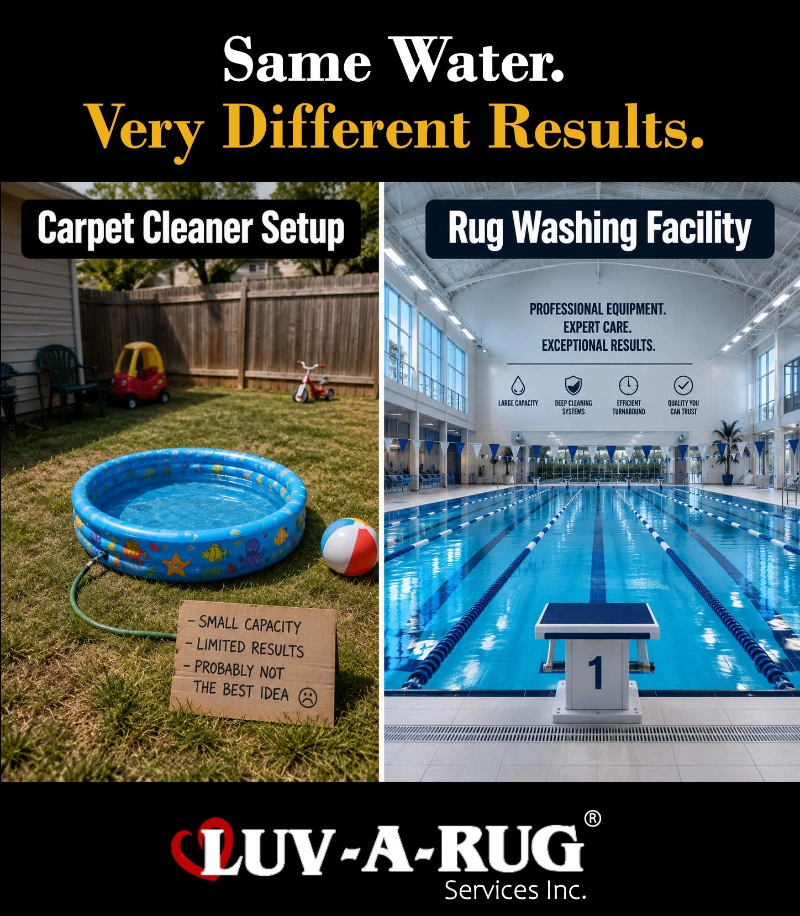
The same basic principle applies to cleaning area rugs.
Carpet cleaning equipment was designed for carpets
Wall-to-wall carpet has one enormous advantage when it comes to cleaning:
It doesn't move.
It's attached to the floor, which means the cleaner must bring the cleaning process to the carpet.
Professional carpet-cleaning systems are therefore designed to work **in place**. Depending on the system being used, soil is loosened and removed from the carpet while controlling how much moisture reaches the material underneath.
That's exactly what you want when your carpet is permanently attached to your house.
An area rug, however, has committed itself to a much more adventurous lifestyle.
It can be rolled up.
Moved.
Turned over.
Inspected from both sides.
Dusted.
Washed.
Rinsed.
And dried in a controlled environment.
Once a rug leaves the house, you're no longer limited to cleaning it as though somebody has nailed it to the living-room floor.
And that opens up an entirely different way of doing things.
Rug washing treats the rug as a complete textile
An area rug isn't just the fuzzy part you walk on.
It has a pile or face fibre, but it also has a foundation beneath it. Depending on how the rug was made, soil, fine grit, pet contaminants and other material can work their way deeper into that structure over time.
Some of this material is remarkably determined.
It does not see your vacuum cleaner as a threat.
It sees your vacuum cleaner as weather.
This is why professional rug washing often begins **before water ever touches the rug**.
At Luv-A-Rug] rugs are handled in a dedicated rug washing facility where they can be inspected and treated as individual textiles rather than simply cleaned as another section of flooring.
That distinction matters.
A rug can be examined for construction, fibre type, colour stability, contamination, wear and other factors before the appropriate cleaning process is selected.
In other words, the rug gets treated like a rug.
Which sounds obvious until you realize how often rugs are treated like unusually portable carpet.
Why removing dry soil matters
One of the less glamorous truths about rugs is that they can contain an impressive amount of dry particulate soil.
Dust.
Sand.
Fine grit.
Tiny bits of whatever civilization has been dragging indoors for the last several years.
Vacuuming certainly helps, but deeply embedded particles can work down into the rug's foundation.
This is one reason specialized rug-cleaning processes may include a dedicated dry-soil removal or dusting stage before washing.
Because adding water to a large quantity of embedded dirt does not magically improve the dirt.
It creates wet dirt.
Human civilization has spent thousands of years advancing beyond this technology.
## Then comes the washing
Once appropriate testing and preparation have been completed, a washable rug can be cleaned using methods suited to its construction and condition.
This can allow the cleaning solution and water to move through more of the rug rather than concentrating only on the exposed surface.
Proper rinsing is important too.
If something has been loosened from the rug, ideally you want that something to leave the rug.
This sounds like a modest ambition.
Yet it is surprisingly central to cleaning.
The goal isn't simply to make the top fibres look better. The goal is to remove as much appropriate soil and contamination as reasonably possible while protecting the rug.
That is the fundamental difference in **rug washing vs carpet cleaning**.
One process is designed primarily around cleaning installed carpeting.
The other can be built around the rug itself.
Does that mean carpet cleaning an area rug is always wrong?
No.
And this is where the internet occasionally gets itself into trouble because it prefers answers that can be shouted.
Some area rugs can absolutely be cleaned using lower-moisture or carpet-cleaning methods.
In fact, the correct method depends on the rug.
Construction matters.
Fibre matters.
Dyes matter.
Backing materials matter.
Age matters.
Condition matters.
Previous cleaning attempts may matter.
The mysterious thing your Labrador did in 2021 may matter considerably.
There are rugs that shouldn't simply be saturated with water. There are rugs containing materials or dyes that require special handling. Some rugs may need alternative cleaning approaches altogether.
This is why professional inspection matters more than slogans.
Organizations such as The WoolSafe Organisation provide consumer guidance on the cleaning and maintenance of wool carpets and rugs, reinforcing the importance of using appropriate products, procedures and professional knowledge when caring for wool textiles.
The real question isn't:
**“Which cleaning method uses more water?”**
It's:
**“Which cleaning method is appropriate for this particular rug?”**
Why a dedicated rug washing facility changes what's possible
Take another look at the image above.
On the left we have a tiny children's pool.
On the right we have something resembling the aquatic headquarters of a small nation.
Technically, both are swimming facilities.
Nobody is confused about which one has greater capabilities.
A dedicated rug washing facility creates a similar difference in scale and possibility.
Because the rug can be removed from the home, technicians can potentially work on both sides, remove dry soil before cleaning, treat contamination, rinse the rug more thoroughly when appropriate, control water removal and manage the drying environment.
You aren't trying to reproduce an entire rug-cleaning plant beside someone's coffee table while carefully avoiding the antique sideboard.
You have a facility designed around the job.
What about pet urine and odours?
This is where the difference can become particularly important.
A contaminant that reaches only the surface is one thing.
A contaminant that has travelled through the pile and into the rug's foundation is another.
Surface cleaning may improve what you see and smell without necessarily addressing everything that has travelled deeper into the rug.
And unfortunately, pet urine has never demonstrated much respect for property boundaries.
It does not politely stop at the top of the fibre and say:
*"I believe I've gone far enough."*
When contamination has penetrated deeper into a rug, being able to treat the entire textile can become especially valuable.
Again, the treatment has to be appropriate for the particular rug. But having access to the whole rug gives a specialist options that simply don't exist when the rug is being treated like installed carpet.
So what is the real difference between rug washing and carpet cleaning?
The simplest answer is this:
**Carpet cleaning is generally designed around cleaning a textile that must stay where it is. Professional rug washing can be designed around cleaning a textile that can be taken somewhere specifically equipped to care for it.**
That seemingly small difference changes almost everything.
How the rug can be inspected.
How dry soil can be removed.
How it can be washed.
How thoroughly it can be rinsed.
How water can be extracted.
How it can be dried.
And how individual problems can be addressed along the way.
Same water. Very different results.
Water isn't the remarkable part.
The process is.
A garden hose and the Bellagio fountains both contain plumbing, but nobody travels to Las Vegas to admire Steve washing the patio.
Equipment matters.
Facilities matter.
Training matters.
Inspection matters.
And above all, choosing the correct process for the rug matters.
So if you're comparing **rug washing vs carpet cleaning**, don't simply ask whether somebody can clean an area rug.
Ask **how** they're going to clean it.
Ask whether the rug is being cleaned in place or at a dedicated facility.
Ask whether dry soil is removed before washing.
Ask how the rug will be rinsed.
Ask how it will be dried.
Ask whether the cleaning method is selected according to the rug's fibres, construction, dyes and condition.
Because two cleaning companies may both say they “clean rugs.”
Just as two places may both say they have a swimming pool.
And somewhere, a toddler with an inflatable duck is technically proving them right.